Assessing Collaborative Efforts
As I mentioned in this past week's discussion assignment, besides the importance of the group dynamic in most every human activity, there is the overarching importance of self-determinism that should be held as one of the most important values that an educator should be consulting in the course of helping a student to develop new skills or gain new understandings. The individual is the target of the education process. Groups are composed of individuals. Yes, you can train teamwork and help to develop group skills and this can be seen and experienced in most of our common sports. The trick is to maintain a healthy balance between individual and team values. The strength of a free society is probably due to its granting individual freedoms.
If done correctly, students respond to collaborative assessment the same way they respond to learning a new game. They want to participate. Group activities are natural for people. In my science classes, I would schedule several, in class, group activities each week. These were problem- based assignments which the students had to solve in groups. They were graded on their solutions and each of them was graded on his or her participation. They were assigned to groups based on their seating arrangements. They chose these themselves at the beginning of the term. Usually, they were seated near other students which they worked best with. Usually, there were students who were less socially oriented and a teacher has to notice this and compensate for it. Don't let little Joey sit out the game on the bench. Let him and someone else practice throwing and catching the ball. Find an acceptable group for each student. Sometimes the teacher must work with a student or two in a group. The same mechanics work online but would probably require surveys to establish optimum group structures.
Another problem, also cited earlier, is that many students are better adjusted socially than their teachers or school staff. There's nothing really wrong with that. The Hurst and Thomas study (Hurst and Thomas, 2008) was probably following the dynamics that youngsters had already developed within the internet structure. The youth of this world seem to be way ahead of the rest of us on the social aspects of the internet. Treat it like recess and use it to help form good solid communities. Adult learners need more structure. Keeping the direction of group activities becomes easier when you intend to keep the fun of learning in sight.
Hurst , Deborah and Thomas, Janice (2008). Towards a theory of online learning. In Anderson, T. (Ed.) The theory and practice of online learning (Chapter 18). (pp. 441-472). Edmonton, AB: AU Press, Athabasca University.
Palloff, Rena M, Pratt, Keith, (2005). Collaborating Online, Learning Together in Community, San Fransisco. CA, : Jossey-Bass.
Vodcasts:
“Assessment of Collaborative Learning Environments” George Siemans more acceptance /global extensions. Retrieved from web page EDUC - 8842, Walden University, (2010)
"Learning Communities" George Siemans more acceptance/global extensions. Retrieved from web page EDUC - 8842, Walden University, (2010)
For Module 3, I responded to the following 2 blogs:
Christine Rand: http://walden-crand.blogspot.com/2010/06/module-2_29.html
Amy Cantymagli: http://acantymagli.blogspot.com/
Wednesday, July 14, 2010

Sunday, July 11, 2010
Video Presentation: Post OutlineStoryboard on Blog
Outline:
Distance Education - Title
Learning Content - Narrated Animation as a pre-introduction posed as a question -
Should Learning Content in Distance
Education be the Same as Learning Content
in the Traditional Classroom Format?
Introduction - Narrated with pictures -
Hypotheses and Rationale for the Adaptation
of Learning Content to Distance Education
1. The principles that apply to learning are
fundamentally the same regardless of the
medium.
2. The systems or mechanics of presentation
of learning content vary considerably from
one medium to another.
3. The learning content for distance education
should be adapted for the working medium,
whether it be books at home that are shipped
by mail, or a fully online format, or any hybrid
system, to produce optimum learning for the
student at optimum efficiency for the system.
Distance Education Plans
Course Planning for Online Adult Learners - Introduction of key speakers and their ideas - Narration and video
DuCharme-Hansen, B., & Dupin-Bryant, P.
(2005). Distance Education Plans: Course
Planning for Online Adult Learners. TechTrends
Linking Research and Practice to Improve
Learning, 49(2), 31-39. Retrieved from ERIC database.
Six components of distance education plans
assessment
guidance
building community
communication
humanizing
evaluating
DuCharme-Hansen and Pamela A. Dupin-Bryant
What are the Student’s Concerns? - Narration about student attitudes - includes pictures -
Some Learner-Based Values:
Ease in paying attention to Instructors' materials
Ability of instructor to pay attention to students
Ease of reading graphics and visuals
Instructor answers questions
Examples and activities helped the student to learn
Faculty seemed knowledgeable about all topics.
(Stewart, Barbara L. et al 2004)
Developing web-based curricula: issues and challenges - Narration and video
Model for Effective Curriculum Development
Define target students and their needs
Identify instructional objectives
Select the scope of subject content
Organize sequence and structure
Select presentation methods and media
Design assessment activities
Implement formative evaluation
(Chou and Tsai 2002)
Summary and Introduction to our Speakers - Probably Barbara DuCharme and Pamela
Dupin-Bryant - videos and/or narration
For the Video Presentation Story Line Blog, I responded to the following 2 blogs:
Christine Rand: http://walden-crand.blogspot.com/2010/06/module-2_29.html
Amy Cantymagli: http://acantymagli.blogspot.com/
Distance Education - Title
Learning Content - Narrated Animation as a pre-introduction posed as a question -
Should Learning Content in Distance
Education be the Same as Learning Content
in the Traditional Classroom Format?
Introduction - Narrated with pictures -
Hypotheses and Rationale for the Adaptation
of Learning Content to Distance Education
1. The principles that apply to learning are
fundamentally the same regardless of the
medium.
2. The systems or mechanics of presentation
of learning content vary considerably from
one medium to another.
3. The learning content for distance education
should be adapted for the working medium,
whether it be books at home that are shipped
by mail, or a fully online format, or any hybrid
system, to produce optimum learning for the
student at optimum efficiency for the system.
Distance Education Plans
Course Planning for Online Adult Learners - Introduction of key speakers and their ideas - Narration and video
DuCharme-Hansen, B., & Dupin-Bryant, P.
(2005). Distance Education Plans: Course
Planning for Online Adult Learners. TechTrends
Linking Research and Practice to Improve
Learning, 49(2), 31-39. Retrieved from ERIC database.
Six components of distance education plans
assessment
guidance
building community
communication
humanizing
evaluating
DuCharme-Hansen and Pamela A. Dupin-Bryant
What are the Student’s Concerns? - Narration about student attitudes - includes pictures -
Some Learner-Based Values:
Ease in paying attention to Instructors' materials
Ability of instructor to pay attention to students
Ease of reading graphics and visuals
Instructor answers questions
Examples and activities helped the student to learn
Faculty seemed knowledgeable about all topics.
(Stewart, Barbara L. et al 2004)
Developing web-based curricula: issues and challenges - Narration and video
Model for Effective Curriculum Development
Define target students and their needs
Identify instructional objectives
Select the scope of subject content
Organize sequence and structure
Select presentation methods and media
Design assessment activities
Implement formative evaluation
(Chou and Tsai 2002)
Summary and Introduction to our Speakers - Probably Barbara DuCharme and Pamela
Dupin-Bryant - videos and/or narration
For the Video Presentation Story Line Blog, I responded to the following 2 blogs:
Christine Rand: http://walden-crand.blogspot.com/2010/06/module-2_29.html
Amy Cantymagli: http://acantymagli.blogspot.com/
Wednesday, June 30, 2010
Elements of Distance Education Diffusion
George Seimens speaks of "global diversity as a common trend within distance education" while discussing the evolution of online education, (Siemens, G. 2010). This is evident. The assignment is to respond to two elements:
· How has this element evolved"
· What online tools are available today to facilitate these interactions among learners?
Global diversity within distance education has had a parallel evolution to the internet itself. Indeed, the internet has evolved directly with the extension of the telephone system across the planet using communication satellites that provide a more efficient method to reach terminals abroad. These technological improvements, together with innovative electronic data manipulative systems have given rise to a highly effective global communication system. From text messaging within university systems here in the US, that serviced students at home responding to lesson assignments, to a fully global network of synchronous and non-synchronous programs, the scope, facility, and complexity that provides effective and well designed courses at a very high and unique level of convenience.
Today we have video tools (Siemens, G. 2010) as well as text and audio tools with which to reach diverse global populations. In addition, we have the non-synchronous aspect of message boards as well as the various other messaging options available to internet users. We also have developing theories like "Equivalency Theory" (Simonson, M., 2010) that assist toward formats that are uniquely designed for online distance education.
An important aspect of the facilitation of global diversity that should not be minimized is that there is no cost penalty for longer distance communications within today's internet structure. It would not be totally surprising, given the current ethics of online business practices, to see this change, but the driving force for global interaction will probably prove strong enough to continue to suppress any unethical motives, at least for the near future.
Siemens, G. (2010) ) Vodcast: Equivalency Theory. Retrieved from EDUC 7102, Walden University Webpage.
Simonson, M. (2010) Vodcast: Equivalency Theory. Retrieved from EDUC 7102, Walden University Webpage.
For Module 2, I responded to the following 2 blogs:
Christine Rand: http://walden-crand.blogspot.com/2010/06/module-2_29.html
Richard Wasserman: http://principlesofdistanceeducationwaldenu.blogspot.com/2010/06/module-2.html
George Seimens speaks of "global diversity as a common trend within distance education" while discussing the evolution of online education, (Siemens, G. 2010). This is evident. The assignment is to respond to two elements:
· How has this element evolved"
· What online tools are available today to facilitate these interactions among learners?
Global diversity within distance education has had a parallel evolution to the internet itself. Indeed, the internet has evolved directly with the extension of the telephone system across the planet using communication satellites that provide a more efficient method to reach terminals abroad. These technological improvements, together with innovative electronic data manipulative systems have given rise to a highly effective global communication system. From text messaging within university systems here in the US, that serviced students at home responding to lesson assignments, to a fully global network of synchronous and non-synchronous programs, the scope, facility, and complexity that provides effective and well designed courses at a very high and unique level of convenience.
Today we have video tools (Siemens, G. 2010) as well as text and audio tools with which to reach diverse global populations. In addition, we have the non-synchronous aspect of message boards as well as the various other messaging options available to internet users. We also have developing theories like "Equivalency Theory" (Simonson, M., 2010) that assist toward formats that are uniquely designed for online distance education.
An important aspect of the facilitation of global diversity that should not be minimized is that there is no cost penalty for longer distance communications within today's internet structure. It would not be totally surprising, given the current ethics of online business practices, to see this change, but the driving force for global interaction will probably prove strong enough to continue to suppress any unethical motives, at least for the near future.
Siemens, G. (2010) ) Vodcast: Equivalency Theory. Retrieved from EDUC 7102, Walden University Webpage.
Simonson, M. (2010) Vodcast: Equivalency Theory. Retrieved from EDUC 7102, Walden University Webpage.
For Module 2, I responded to the following 2 blogs:
Christine Rand: http://walden-crand.blogspot.com/2010/06/module-2_29.html
Richard Wasserman: http://principlesofdistanceeducationwaldenu.blogspot.com/2010/06/module-2.html
Wednesday, June 16, 2010
The Next Generation of Distance Education
"Don't throw the baby out with the bathwater." (Saying, Anonymous).
Granted, not everything is perfect with traditional forms of education, but, let's not throw away our textbooks, whiteboards (blackboards that are white), or our words or tradtional methods quite yet. I don't see that it's justifiable to replace Euclid (the person credited with the development of geometric theory) or Webster (the lexicographer) with ACT - R and John Robert Anderson or Marshall, S. and the belief that traditional education might actually inhibit learning (Moller et al. 2008 May/June) just at this moment. Forgive any sarcasm, but as a long term dedicated science teacher and engineer, I don't feel it's fitting to take a broadside against what I do laying down. My first career was as an engineer. I worked for the Apollo program at RCA, Hightstown, N.J. We designed and built one of the cameras that transmitted live telecasts of the the moon landings and helped develop microtechnologies and telecommunications which we are using right now in devices like the computer and internet. My part was very small. Still, I think the generalizations about traditional education do more damage that good.
I tend to agree with Simonson (Simonson, M. 2010) in his discussion about Equivalency Theory where he makes the point that e-learning is a different forum altogether and that instructional design should simply take this into account.
I'm not a pedestrian here. I have done curriuculm design for a distance education school. I do function as an instructor for a distance education school. I have worked in public education for a number of years as well. There's a thing called "don't unmock a working installation". In short it means "if it works, don't fix it". There's a practicality here - when I worked in engineering we called it common sense. I have no idea what it's called in ACT - R. It's probably thought of as quaintly archaic - like survival of the human race or something similarly silly.
What I'm getting at is that many of these problems have alreadey been solved, eg, incorporating highly complex theory into a learnable module, by professionals who publish textbooks.
What great stretch of the imagination is required to extend this application to e-learning? Take a look at a modern textbook. They are incredibly fine pieces of learning technology as well as beautifully presented. They have to be to extract a reasonable ROI - excuse the acronym (return on investment). Here's something that's working and has a proven track record. It holds up well against current state and national educational standards. Why not simply use it?
Now, I agree that educators should be formulating these programs and working closer in on any technology involving learning. I'm a science teacher but I've studied business management as well and I certainly understand the need and value of training in any organization. Yes, I can definitely see business training e-learning threatened by the lack of trained educators in the development of their training curriculum. These are all good points and tend to emphasize the need for professional educators to lend a hand in helping to develop useful study programs in other areas than K-12 or higher learning. As educators, we all feel the needs of our society for adequate training. Let's not lose our focus though. Let's not drop the vital areas of education that we are already handling to tend to this new emergency. Let's not change horses midstream . Let's be reasonable and effective.
In summary, I'd reinforce the rationale of Simonson and take heed to Moller et al and the warnings about the need for professional educators to become more involved. I'd totally ignore and occasionally point out the absurdity of unmocking (taking apart) what currently works in education, run it up the flagpole and see who salutes.
Moller, L., Foshay, W., & Huett, J. (2008, May/June). The evolution of distance education: Implications for instructional design on the potential of the Web (Part 1: Training and Development). TechTrends, 52(3), 70–75.
Moller, L., Foshay, W., & Huett, J. (2008, July/August). The evolution of distance education: Implications for instructional design on the potential of the Web (Part 2: Higher Education). TechTrends, 52(4), 66–70.
Huett, J., Moller, L., Foshay, W. & Coleman, C. (2008, September/October). The evolution of distance education: Implications for instructional design on the potential of the Web (Part 3: K12). TechTrends, 52(5), 63–67.
Simonson, M. (2010) Vodcast: Equivalency Theory. Retrieved from EDUC 7102, Walden University Webpage.
Granted, not everything is perfect with traditional forms of education, but, let's not throw away our textbooks, whiteboards (blackboards that are white), or our words or tradtional methods quite yet. I don't see that it's justifiable to replace Euclid (the person credited with the development of geometric theory) or Webster (the lexicographer) with ACT - R and John Robert Anderson or Marshall, S. and the belief that traditional education might actually inhibit learning (Moller et al. 2008 May/June) just at this moment. Forgive any sarcasm, but as a long term dedicated science teacher and engineer, I don't feel it's fitting to take a broadside against what I do laying down. My first career was as an engineer. I worked for the Apollo program at RCA, Hightstown, N.J. We designed and built one of the cameras that transmitted live telecasts of the the moon landings and helped develop microtechnologies and telecommunications which we are using right now in devices like the computer and internet. My part was very small. Still, I think the generalizations about traditional education do more damage that good.
I tend to agree with Simonson (Simonson, M. 2010) in his discussion about Equivalency Theory where he makes the point that e-learning is a different forum altogether and that instructional design should simply take this into account.
I'm not a pedestrian here. I have done curriuculm design for a distance education school. I do function as an instructor for a distance education school. I have worked in public education for a number of years as well. There's a thing called "don't unmock a working installation". In short it means "if it works, don't fix it". There's a practicality here - when I worked in engineering we called it common sense. I have no idea what it's called in ACT - R. It's probably thought of as quaintly archaic - like survival of the human race or something similarly silly.
What I'm getting at is that many of these problems have alreadey been solved, eg, incorporating highly complex theory into a learnable module, by professionals who publish textbooks.
What great stretch of the imagination is required to extend this application to e-learning? Take a look at a modern textbook. They are incredibly fine pieces of learning technology as well as beautifully presented. They have to be to extract a reasonable ROI - excuse the acronym (return on investment). Here's something that's working and has a proven track record. It holds up well against current state and national educational standards. Why not simply use it?
Now, I agree that educators should be formulating these programs and working closer in on any technology involving learning. I'm a science teacher but I've studied business management as well and I certainly understand the need and value of training in any organization. Yes, I can definitely see business training e-learning threatened by the lack of trained educators in the development of their training curriculum. These are all good points and tend to emphasize the need for professional educators to lend a hand in helping to develop useful study programs in other areas than K-12 or higher learning. As educators, we all feel the needs of our society for adequate training. Let's not lose our focus though. Let's not drop the vital areas of education that we are already handling to tend to this new emergency. Let's not change horses midstream . Let's be reasonable and effective.
In summary, I'd reinforce the rationale of Simonson and take heed to Moller et al and the warnings about the need for professional educators to become more involved. I'd totally ignore and occasionally point out the absurdity of unmocking (taking apart) what currently works in education, run it up the flagpole and see who salutes.
Moller, L., Foshay, W., & Huett, J. (2008, May/June). The evolution of distance education: Implications for instructional design on the potential of the Web (Part 1: Training and Development). TechTrends, 52(3), 70–75.
Moller, L., Foshay, W., & Huett, J. (2008, July/August). The evolution of distance education: Implications for instructional design on the potential of the Web (Part 2: Higher Education). TechTrends, 52(4), 66–70.
Huett, J., Moller, L., Foshay, W. & Coleman, C. (2008, September/October). The evolution of distance education: Implications for instructional design on the potential of the Web (Part 3: K12). TechTrends, 52(5), 63–67.
Simonson, M. (2010) Vodcast: Equivalency Theory. Retrieved from EDUC 7102, Walden University Webpage.
Thursday, June 10, 2010
Wednesday, November 11, 2009
Overcoming adversity to new technologies using motivational techniques
I had a great deal of difficulty getting the OK to install a new weather station on the roof of our school in Philadelphia. The technological enhancements for our science course included the weather station and an online interface, as well as an auxiliary course by the American Meteorological Society. We had ample budget, but justifying the cost as well as explaining the different functions was quite trying. The attitudes were quite negative. The behaviors demonstrated a low interest in learning anything about new technologies.
What I finally did came right off the materials from the AMS! It said: "Conduct a workshop for the administration and faculty..." And so I did. It followed the ARCS model fairly accurately!
The workshop contained a hands-on lab - real hands on real paper - drawing numbers at your fingertips over and over as you drew your palm upward and around to demonstrate the wind flows at high and low pressure systems. This really got their attention - and about the time that the data came streaming in from an online weather source, the classroom was abuzz with enthusiam and most everyone was busily making predictions for the following day's weather! Confidence was way up and, by the brightness of their eyes and their laughter, I knew the satisfaction was high and I had a winner!
By the way, the course itself did extremely well in terms of student engagement and comprehension of the major concepts.
What I finally did came right off the materials from the AMS! It said: "Conduct a workshop for the administration and faculty..." And so I did. It followed the ARCS model fairly accurately!
The workshop contained a hands-on lab - real hands on real paper - drawing numbers at your fingertips over and over as you drew your palm upward and around to demonstrate the wind flows at high and low pressure systems. This really got their attention - and about the time that the data came streaming in from an online weather source, the classroom was abuzz with enthusiam and most everyone was busily making predictions for the following day's weather! Confidence was way up and, by the brightness of their eyes and their laughter, I knew the satisfaction was high and I had a winner!
By the way, the course itself did extremely well in terms of student engagement and comprehension of the major concepts.
Friday, October 30, 2009
Connectivism
Mind Mapping
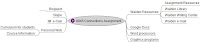
Click on the image to enlarge it!
The major change I've realized using the ICT networks has been the speed and convenience the new tools allow.
It's an interesting exercise to use this assignment on "mind mapping" as an example.
The example above is a first try of sorts and, of course, barely expresses what I had in mind to present. Nevertheless, there are ample tools that would lend themselves quickly and easily to use that would save an enormous amount of time to develop a good graphical demonstration for this assignment.
The internet search engines, the computer word processors and certainly the distance learning connections do an incredible job of making the learning process much easier and less frustrating.
I have my own methods of learning new things, but the internet and word processing tools have sped things up significantly. It is very easy, for example, to find satisfactory resources for most references. I always had good resources available in my study, but would have to spend many an hour in libraries on tasks that would take less than a minute today!
Mind Mapping

Click on the image to enlarge it!
The major change I've realized using the ICT networks has been the speed and convenience the new tools allow.
It's an interesting exercise to use this assignment on "mind mapping" as an example.
The example above is a first try of sorts and, of course, barely expresses what I had in mind to present. Nevertheless, there are ample tools that would lend themselves quickly and easily to use that would save an enormous amount of time to develop a good graphical demonstration for this assignment.
The internet search engines, the computer word processors and certainly the distance learning connections do an incredible job of making the learning process much easier and less frustrating.
I have my own methods of learning new things, but the internet and word processing tools have sped things up significantly. It is very easy, for example, to find satisfactory resources for most references. I always had good resources available in my study, but would have to spend many an hour in libraries on tasks that would take less than a minute today!
Subscribe to:
Posts (Atom)

